


Digital Twins · 6 min read
What Dubai's digital twin platformmeans for private asset owners
Dubai now has a living 3D model of 195,000 buildings. The question every private asset owner should be asking this year is why their own portfolio doesn't.
Published 14 July 2026 · AIN UAE

Dubai’s Digital Twin platform covers more than 195,000 buildings and roughly 330,000 infrastructure assets. Image: Dubai Media Office / hamdan.ae
What was actually announced
In July 2026, Dubai's Crown Prince Sheikh Hamdan bin Mohammed launched an integrated Digital Twin platform covering more than 195,000 buildings and roughly 330,000 infrastructure assets across the emirate. Built to support urban planning, traffic and utility management, rainfall simulation and evacuation planning, it is one of the most ambitious municipal digital twin deployments in the world.
The platform is an AI-enabled 3D model built from aerial, satellite and ground survey data, integrated with municipal datasets. It gives government departments a single, queryable view of the built environment, building by building, asset by asset, rather than the fragmented mix of PDFs, spreadsheets and paper drawings most organisations still rely on.
Dubai Municipality already mandates BIM for large and complex projects, and this platform extends that logic from individual buildings to the entire city. The direction of travel is unambiguous: structured, geo-referenced, continuously updated 3D data is becoming the default way Dubai expects its built environment to be documented and managed.
Why this matters beyond government
For anyone outside government, the news is easy to read as interesting but not relevant. That would be a mistake. The platform is a signal, not a curiosity. Three groups should be paying close attention.
- Developers and asset owners, because portfolio-level digital twins are quickly becoming the expected standard for how institutional-grade real estate is documented, valued and insured.
- Engineering consultancies and PMCs, because clients working alongside government-linked projects will increasingly expect deliverables compatible with, or benchmarked against, this kind of live 3D data model.
- Facilities management teams, because a citywide precedent for real-time asset visibility raises the bar for what good asset management looks like at the individual building level.
None of this means private owners need a 195,000-building platform. It means the gap between how the city documents its assets and how most private portfolios document theirs is now wide enough to be a competitive and operational disadvantage.
The gap between city-scale and asset-scale digital twins
Most private buildings and infrastructure assets in the UAE are still documented the way they were ten years ago: a folder of as-built drawings, a maintenance log, and photos taken during the last inspection walk-through. When a facade shows signs of distress, when a warranty dispute arises, or when an insurer asks for evidence of ongoing condition monitoring, teams are often reconstructing a history that was never properly captured.
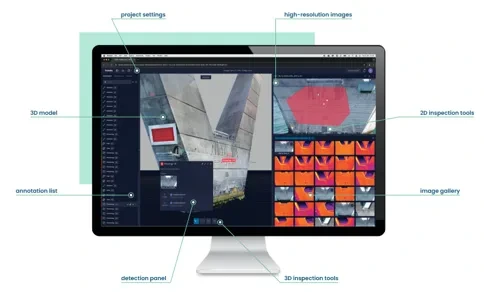
A building- or portfolio-level digital twin closes that gap. Built from high-precision drone photogrammetry and, where relevant, thermal or multispectral data, it creates a time-stamped, geo-referenced 3D record of an asset's condition: the private-sector equivalent of what Dubai has built at city scale, scoped to a single site, campus or portfolio.
What this means in practice
- Compliance and audit expectations will keep rising. Insurers, lenders and regulators increasingly expect defensible, dated evidence of asset condition, not verbal assurance that it was inspected.
- BIM-compatible data is becoming table stakes. Deliverables that plug directly into Revit, Bentley or Civil 3D save engineering teams weeks of reformatting.
- Digital twins are shifting from one-off survey to living record. Value compounds when inspection data repeats over time, so condition changes, crack propagation, thermal anomalies, settlement, can be tracked rather than guessed at.
- Data ownership matters. As more of this data sits in cloud platforms, hosting, access control and data sovereignty are becoming part of the procurement conversation, not an afterthought.
Getting started without waiting for a mandate
There is no indication that Dubai intends to require private owners to adopt city-style digital twins. But the organisations that move early, building a structured, GCAA-compliant, BIM-ready record of their own assets, will be the ones with a genuine evidence base when a maintenance decision, insurance claim or audit lands on their desk, rather than a filing cabinet of disconnected reports.
If you manage buildings for a developer, consultancy or FM team, the practical starting point is a single baseline capture of one representative asset. See how facilities management teams and engineering consultancies typically scope that first survey.
About AIN UAE
GCAA & DCAA licensed drone data and digital twin company
Based in Dubai, working with developers, PMCs, engineering consultancies and facilities teams across the UAE and GCC. We build asset-level digital twins from drone photogrammetry and thermal data, delivered in formats that plug directly into Revit, Bentley and standard GIS platforms.
Talk through your portfolio