Home → Solutions →
Browse solution services Digital Twin Platform Asset & Structural Inspection Photogrammetry & 3D Mapping Multispectral Agriculture Aerial Filming Drone Cleaning Solar Panel Inspection Thermal & Infrared Inspection
Industries → Case Studies → Insights → About → Contact →

Oil & gas asset integrity

Oil refinery façade inspection & digital twins in the UAE

AIN UAE supports oil and gas asset-integrity teams with visual drone inspection, thermal and infrared surveys, and digital twin condition records. Methane and gas-leak detection is delivered with a specialist partner using an agreed sensor and inspection method.

Refinery inspection and digital twin walkthrough

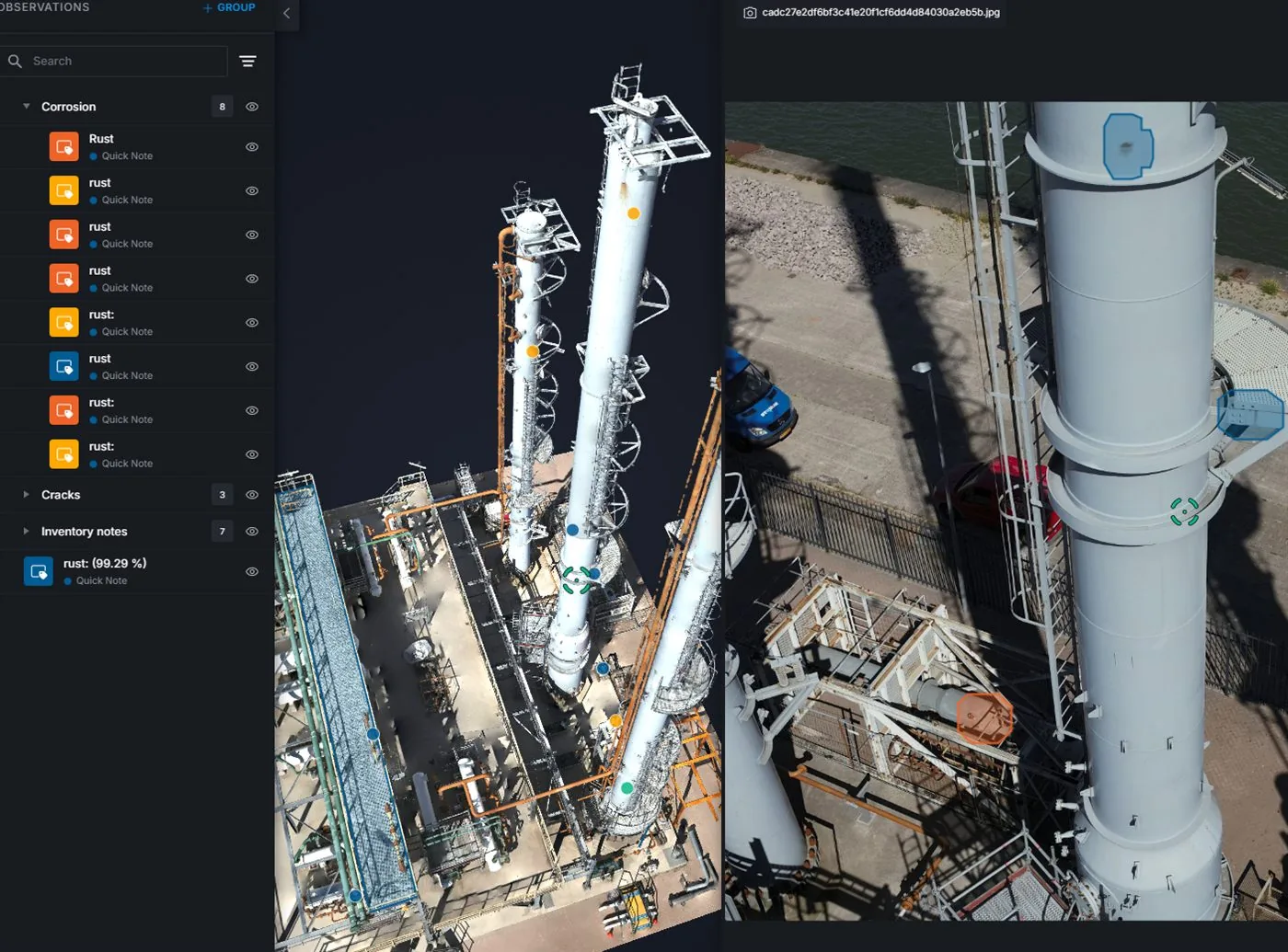
Industrial tower digital twin with corrosion observations linked to a close-up inspection photograph

Illustrative AIN digital twin view: tagged industrial assets linked to inspection photographs. The video is hosted on Vimeo.

Open the video on Vimeo. If playback is unavailable, contact us for an accessible viewing option.

The video is an explanatory walkthrough. The methods below are inspection-scoping options, not a list of confirmed gas leaks, pipe cracks, measured temperatures or repairs from this project. No client, location, inspection date or quantified result is asserted here.

From reactive maintenance to an asset-condition record

Recurring call-outs, repeated access arrangements and disconnected photographs can leave a maintenance backlog without a clear history of each finding. A dated inspection baseline helps reliability, inspection and maintenance teams decide what needs closer investigation and what should be compared at the next survey.

From condition review to maintenance follow-up

Use the record to support asset-integrity review, reliability planning, risk-based inspection and leak detection and repair (LDAR) programmes where a specialist gas survey is commissioned. No prediction of every failure or fixed maintenance saving is promised.

Published oil and gas inspection benchmarks

External examples and published estimates, not measured AIN project results or guaranteed savings. Assets, systems and scopes differ; the named organisations are not presented as AIN clients or partners.

Estimated inspection cost reduction
Up to 70%
Aker Solutions’ 2025 estimate for autonomous offshore inspection. A different operating model, not a measured AIN saving. Source: Aker Solutions
Estimated inspection time reduction
Up to 50%
GE’s published pilot-stage estimate for drones and other robots, depending on the asset. Not a promised project duration. Source: GE
Targeted visual check
Within 15 min
DJI’s 2020 Shell Deer Park example: a stack-handrail video for engineer review within 15 minutes, not a full-site inspection. Source: DJI / Shell Deer Park

Assess your project against access arrangements, shutdown windows, capture coverage, analysis and reporting, alongside the value of a digital record for repeat review. Actual savings need a site-specific baseline and scope.

What each inspection method can assess

RGB inspection of visible asset condition

Document external corrosion, coating breakdown, damaged cladding and visible surface-crack indications on refinery façades, structures and accessible pipework. Scope may include pipe racks, vessel exteriors, columns, stacks, valves and flanges. Visibility, resolution and access determine what can be assessed.

Thermal and infrared inspection

Thermal imaging is also called infrared thermography. Review heat-loss patterns, insulation defects, hot spots and suspected steam leaks on agreed equipment. Thermal imagery indicates surface temperature patterns, not a confirmed diagnosis or the identity of a gas.

Gas and methane leak detection

AIN delivers gas and methane leak detection with a specialist partner, including fugitive-emissions investigations where scoped. The target gas, suitable OGI camera or dedicated gas sensor, survey conditions and reporting method are confirmed for the assignment. Standard RGB or general-purpose thermal cameras do not directly identify methane.

Pipe cracks, CUI and NDT follow-up

Visible pipe-crack indications can be flagged for closer review. Internal cracks, crack depth, wall thickness and corrosion under insulation (CUI) require suitable follow-up, which may include access, insulation removal or non-destructive testing (NDT). An aerial image alone cannot confirm them.

Workflow: from plant requirements to maintenance evidence

  1. Define the asset list, known concerns and the decisions the inspection must support: façade condition, pipe-rack corrosion, insulation performance, steam-system anomalies or gas-leak investigation.
  2. Agree capture coverage, RGB/thermal methods, partner-led gas detection where required, and plant operating conditions. Review permit-to-work (PTW), simultaneous operations (SIMOPS), hazardous-area restrictions, safe separation and shutdown or turnaround windows.
  3. Capture the agreed areas and organise source imagery, asset identifiers, dates and observations. Record inaccessible areas, uncertain findings and any need for NDT or close-up inspection.
  4. Link suitable records to the digital twin and hand over an agreed findings register. The client’s competent engineers determine repair priorities and any follow-up work; repeat surveys can support condition-based maintenance.

Inspection deliverables for integrity and reliability teams

  • An agreed RGB photograph register and annotated findings for captured areas.
  • Thermal images and interpretation notes where radiometric capture is specified, with relevant operating and measurement limitations.
  • A digital twin or 3D asset record with linked evidence and observation locations, where included in scope.
  • A specialist-partner gas/methane survey report where commissioned, with the sensor, target gas, method, limitations and any separately agreed quantification.
  • A structured findings register for agreed maintenance, CMMS/EAM or inspection-team handover. Automatic software integration is not assumed.

What the inspection does not replace

This work supports asset integrity, mechanical-integrity review, risk-based inspection planning and maintenance decisions. It does not replace fixed gas alarms, emergency response, statutory inspection, pressure testing, NDT or engineering fitness-for-service assessment. A digital twin is a record updated through capture; it is not live process monitoring or SCADA unless that separate capability is explicitly specified. No ATEX/IECEx equipment rating, unrestricted live-plant access or guaranteed avoidance of shutdown is implied.

Oil and gas drone inspection questions

Can an ordinary thermal drone camera detect methane gas leaks?

No. General-purpose thermal imagery does not directly identify methane. AIN carries out methane and gas-leak detection with a specialist partner, using a suitable OGI camera or dedicated gas sensor and an agreed field method. Target gases and detection conditions must be specified.

Can RGB or infrared inspection detect pipe cracks?

RGB capture can document visible surface-crack indications where access and image resolution allow. Thermal patterns may flag areas needing investigation, but internal cracks, wall thickness and crack depth need suitable follow-up or NDT. No single image establishes pipe integrity.

How are steam leaks and insulation problems investigated?

Thermal and infrared surveys may reveal abnormal heat-loss patterns around steam lines, valves and insulation. Plant conditions, surface emissivity, reflections and viewing geometry affect interpretation. Suspected steam leaks or insulation defects require technical verification.

How does a refinery digital twin support maintenance?

A digital twin can link captured imagery and observations to an asset location and inspection date. Maintenance teams can review evidence, plan follow-up and compare suitable repeat surveys instead of relying on disconnected photographs. It does not automatically predict failure or certify a repair.

What information should we provide for a refinery inspection scope?

Share the UAE project location, asset types or asset list, known issues, required dates, operating restrictions, permit-to-work requirements and desired deliverables. For gas or methane work, include the target gas and the required detection or reporting objective.

Technical method references

These references explain sensor principles, not AIN project results or a claim that one camera detects every fault.

Scope an oil and gas inspection for your facility

Send the location, asset list, known maintenance concerns, dates, operating restrictions and required outputs. Tell us whether you need RGB condition documentation, thermal/infrared inspection, a digital twin or specialist gas/methane leak detection.

WhatsApp Start a Project