

Agriculture · 6 min read
UAE food security: using drone data to monitor crop performance
A national strategy measured in yield and self-sufficiency lives or dies on whether individual farms hit their targets, and whether anyone can see how they're performing in real time.
Published 27 July 2026 · AIN UAE · Updated
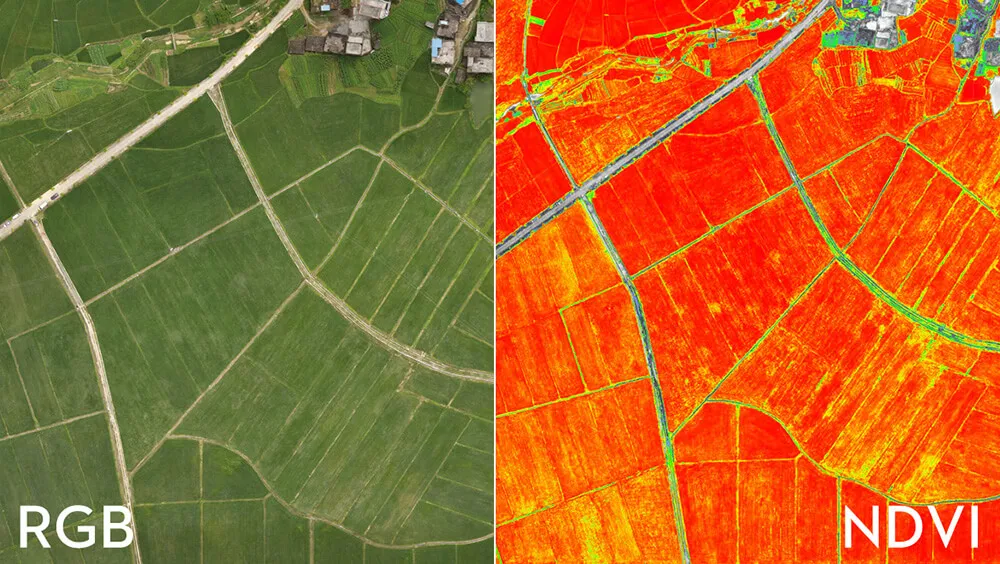
Multispectral and NDVI imaging detects crop and plant stress before it's visible to someone walking the same ground.
The UAE currently imports an estimated 90% of its food, and its National Food Security Strategy wants to flip that, with the explicit goal of becoming the world's most food-secure nation by 2051. The Abu Dhabi Agriculture and Food Safety Authority, the Quality and Conformity Council and ADIO are jointly building a regulatory framework for novel foods, including precision fermentation and cultivated proteins, and recent field results from UAE smart farming projects have already shown greenhouse energy use dropping by more than 60% and cooling water use falling by around 37%, without hurting yields.
Most of the public conversation around this understandably focuses on the exciting parts: novel food technology, greenhouse engineering breakthroughs, new regulatory frameworks for lab-grown and fermented protein. Less attention goes to a much less glamorous, equally decisive layer underneath it all. Can growers and investors actually see, in real time, how these farms and greenhouses are performing on the ground?
The data problem underneath the investment
A national strategy built around cutting import dependency lives or dies on whether individual farms and greenhouses hit their production targets consistently, not just in a research pilot. Desert-climate agriculture doesn't forgive small operational blind spots: a section of a field stressed by uneven irrigation, a greenhouse zone running warmer than the rest, an early pest or disease outbreak that isn't visible to the naked eye for another week. By the time these show up as reduced yield, the growing cycle is often too far along to fully recover.
Multispectral and NDVI imaging exists specifically to close that gap. It detects crop and plant stress, from water deficiency, nutrient issues or early disease, before it's visible to a human walking the same ground. For a national strategy measured in yield and self-sufficiency percentages, that early warning isn't a nice-to-have. It's the whole point.
What a camera sees that a spreadsheet doesn't
- Energy- and water-efficient greenhouse projects need to prove their savings aren't coming at the cost of yield or plant health. Multispectral monitoring provides that evidence either way.
- Precision fermentation and novel-protein ventures still depend on traditional agricultural inputs and feedstock in many cases, subject to the same monitoring needs as conventional crops.
- Investors and government partners funding food security ventures increasingly want operational data, not just harvest totals, to judge whether a project is performing as modelled.
- Large, multi-site agricultural operations, the kind the UAE needs more of to hit its 2051 targets, can't be checked acre by acre on foot at the frequency needed to catch problems early.
How monitoring actually plugs in
Aerial multispectral surveys, flown on a regular schedule across a growing cycle, give growers a field-by-field or greenhouse-by-greenhouse view of plant health, irrigation performance and stress indicators, mapped precisely enough to direct a targeted fix (adjusting one irrigation zone, checking one greenhouse bay) instead of a blanket response. Over a full season, that data becomes a track record too: evidence for investors, government partners and insurers that an operation is actively managed, not just planted and hoped for.
None of this replaces the technology bets the UAE is making on novel food production. It's the monitoring layer that decides whether those bets, and the more conventional farms working alongside them, actually deliver the yields the strategy is counting on.
About AIN UAE
GCAA & DCAA licensed drone data and digital twin company
AIN UAE is a GCAA and DCAA licensed drone data company based in Dubai, working with growers, agri-tech ventures and investors across the UAE and GCC. We capture multispectral and NDVI imagery to monitor crop and plant health across fields and greenhouses, giving operators an early warning of stress and irrigation issues before they hit yield.
Talk through your project