


Construction · 6 min read
Gulf mega-projects keep getting awarded.Proving progress on them is getting harder.
Awards are accelerating even as costs climb. On site, that means more pressure to prove progress cleanly, and in a way that holds up if costs or timelines get questioned later.
Published 27 July 2026 · AIN UAE
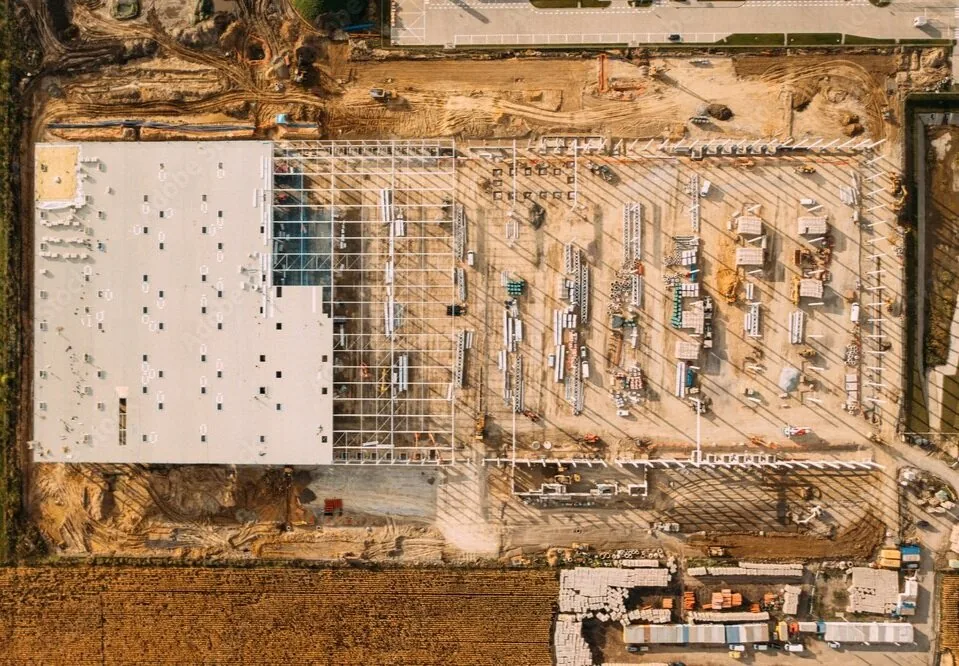
A dated, geo-referenced aerial record gives every party the same evidence of what existed on site on a given day.
A report from Abu Dhabi Commercial Bank, cited by Bloomberg and Arab News on 25 July 2026, forecasts that Saudi Arabia and the UAE will lead a fresh wave of Gulf project awards in the second half of 2026, even as shipping, insurance and construction costs climb because of the regional conflict. ADCB's chief economist Monica Malik put it plainly: the data continues to show a strong willingness to progress with key development plans. The UAE recorded the highest absolute value of project awards in the Gulf during the first half of 2026, and momentum isn't slowing down.
That resilience is good news for the pipeline of work. It's less straightforward for the teams actually delivering it. Rising costs plus an accelerating award schedule usually means one thing on site: more pressure to prove progress cleanly, quickly, and in a way that holds up if costs or timelines get questioned later.
What ADCB actually found
The report's core point is about willingness, not ease. Developers and governments are still committing to major projects despite higher input costs, which suggests confidence in long-term returns even as short-term economics get tougher. But that same cost pressure raises the stakes on execution. When margins tighten, disputes over what was delivered, when, and to what standard become more expensive to get wrong.
More awards doesn't mean fewer problems
A larger pipeline of awarded work usually means more concurrent sites, more subcontractors, and more variation requests as material and labour costs shift mid-project. Each of those generates its own paper trail, and in a rising-cost environment, that paper trail gets scrutinised harder. A contractor claiming a cost variation needs to show, credibly, what conditions actually looked like on site at a given point. A client pushing back on a claim needs the same thing from the other direction.
Where the real cost overruns start
Cost overruns rarely come from one dramatic failure. They usually come from small, poorly documented gaps that compound: a delay nobody can date precisely, a scope change nobody photographed at the time, a quality issue caught too late to argue about cheaply. In a cost environment like the one ADCB is describing, the projects that manage risk best tend to be the ones that treat site documentation as a running record, not an end-of-month formality.
Proof of progress is becoming its own asset
- A geo-referenced, time-stamped aerial record gives every party, client, consultant, contractor, the same visual evidence of what existed on site at a given date, cutting down disputes over whose account is accurate.
- Repeated survey on a fixed schedule creates a defensible trail for variation claims and delay analysis, which matters more, not less, when costs are under pressure.
- Progress data captured this way feeds straight into BIM and digital twin models, so it doesn't need to be recreated at handover or during a dispute.
What to put in place before the next award lands
- Set the survey and reporting cadence in the contract before mobilisation, not after the first disagreement over cost or progress.
- Specify BIM-compatible formats for as-built and progress data so it's usable downstream without rework.
- Keep records centralised and accessible to every stakeholder, not scattered across email threads and personal drives.
About AIN UAE
GCAA & DCAA licensed drone data and digital twin company
AIN UAE is a GCAA and DCAA licensed drone survey and digital twin company working with contractors, PMCs and engineering consultancies across the UAE and GCC. We run progress monitoring, as-built survey and BIM-ready photogrammetry on active construction programmes, with reports formatted to UAE infrastructure standards.
Talk through your project