


Asset Management · 5 min read
57,316 maintenance actions later,Abu Dhabi rewrites the rules for public assets
Abu Dhabi's Department of Municipalities and Transport completed 57,316 preventive maintenance actions in 2026. The shift from calendar-based upkeep to condition-driven maintenance is a benchmark every private portfolio should read closely.
Published 29 July 2026 · AIN UAE
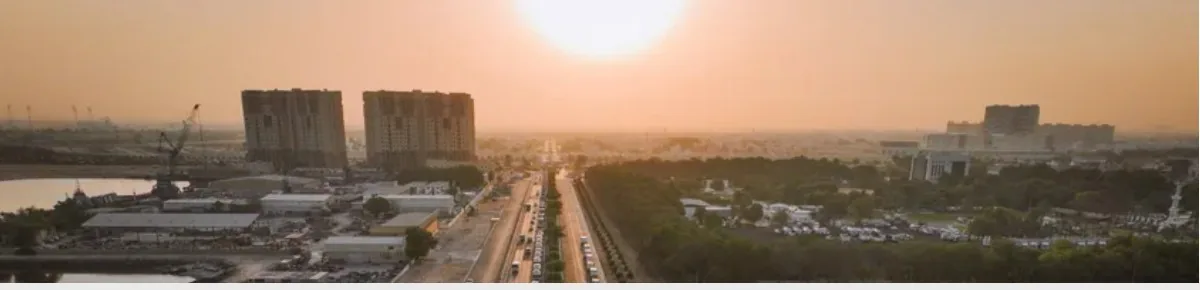
An aerial view over Abu Dhabi road infrastructure. Image: Department of Municipalities and Transport (DMT).
A different way to run public infrastructure
On 28 July, Abu Dhabi's Department of Municipalities and Transport (DMT) announced it had completed 57,316 preventive maintenance actions in 2026, covering roads, pathways, lighting, parks and public facilities across the emirate's three municipalities. The work sits under DMT's Infrastructure Development Directorate (IDD), which coordinates planning and delivery across all three municipal bodies, using inspection results, asset condition information and operational data to decide where crews go next. Eisa Almazrouri, the IDD's Director General, put it plainly: preventive maintenance is “a shift in how urban infrastructure is managed,” moving the focus from reacting to problems after they surface to building systems that catch issues before they do.
That is not a small operational tweak. It is a formal move away from run-to-failure upkeep, toward a model where inspection results and asset condition data, not the calendar, decide what gets fixed and when. Almazrouri frames it as a question of long-term public value: use data, inspections and targeted maintenance to manage assets more effectively, and you get stronger operational performance and fewer surprises, not just a tidier maintenance log.
Why most facilities teams still run on the calendar
Most private developers, facilities management (FM) companies and project management consultancies (PMCs) in the UAE do not have that luxury yet. Their maintenance schedules are built around fixed intervals: quarterly roof checks, annual facade surveys, periodic inspections timed to a lease renewal or an insurance requirement. Not because that is the smart way to protect an asset, but because gathering accurate, site-wide condition data with ground crews is slow, and repeating it often enough to catch problems early gets expensive fast.
The result is predictable. Healthy assets get inspected on a schedule they do not need, while a facade crack, a corroding roof fixing or a drainage blockage on the asset that actually needs attention can sit undetected for months between visits. DMT's own numbers show what is possible once that constraint gets solved: tens of thousands of tracked interventions in a single year, guided by inspection results and condition data rather than a fixed rota.
What does it actually take to get ahead of a fault?
It takes the same three ingredients DMT built its programme around: regular inspection, asset condition monitoring, and a way to prioritise the findings. None of that is exotic. What is hard, for most portfolio owners, is doing it often enough and across enough of the asset base for the data to mean something. A single annual facade survey does not tell an FM company whether deterioration is accelerating. A repeatable, dated record does.
That is where the gap between government-scale programmes and most private portfolios shows up. It is not ambition. It is throughput: how much of a site can get inspected, and how often, without pulling maintenance budgets into ground crews, scaffolding and lane closures.
Closing the gap without growing the ground crew
Aerial data capture changes that math. A single drone flight can cover a rooftop, a facade line or an entire parking structure in a fraction of the time a manual survey takes, without scaffolding, rope access or shutting down the areas underneath. Run on a fixed schedule, it builds exactly the kind of asset history DMT is describing: dated, comparable condition records that show whether a crack, a corrosion patch or a drainage issue is stable or getting worse.
For developers, FM companies and PMCs managing large or spread-out portfolios, that is the practical version of what Abu Dhabi just did at emirate scale: replace intermittent spot checks with a documented, ongoing record of asset condition, built without adding headcount to the maintenance team. The organisations that get there first will not be reacting to Abu Dhabi's new benchmark. They will already be measuring up to it.
Turning a city-scale standard into a portfolio playbook
You do not need 57,316 line items to start. You need a shortlist of the assets where failure is expensive or dangerous: aging facades on occupied towers, flat roofs prone to ponding after summer storms, drainage networks feeding basements and car parks, car park structures carrying live loads every day. Put those on a fixed inspection interval instead of waiting for a tenant complaint or a leak, and keep every report dated, geo-referenced and comparable to the last one.
That last part is where most programmes quietly fail. A facade survey from three years ago and one from last month, shot from different angles by different contractors, are not really comparable. A repeatable aerial capture process, flown the same way each time and delivered as a digital twin, is what turns a folder of PDFs into an actual condition trend, which is the same discipline DMT is applying at the scale of an entire emirate.
About AIN UAE
GCAA & DCAA licensed drone data and digital twin company
AIN UAE is based in Dubai, working with developers, facilities management companies and PMCs across the UAE and GCC. We capture aerial condition data on roofs, facades, parking structures and site infrastructure, delivered as dated, comparable inspection records that support planned maintenance rather than calendar-based upkeep. If you are building a condition-based maintenance programme for your portfolio, we are happy to talk it through.
Talk through your portfolio