


Energy · 5 min read
ADNOC just drilled more than a mile in a day.The real story is the data behind it
ADNOC drilled 6,428 feet in a single 24-hour period using real-time data and AI. The benchmark it just set is not really about drilling — it is about what continuous, data-driven operations demand from every other asset on site.
Published 3 August 2026 · AIN UAE
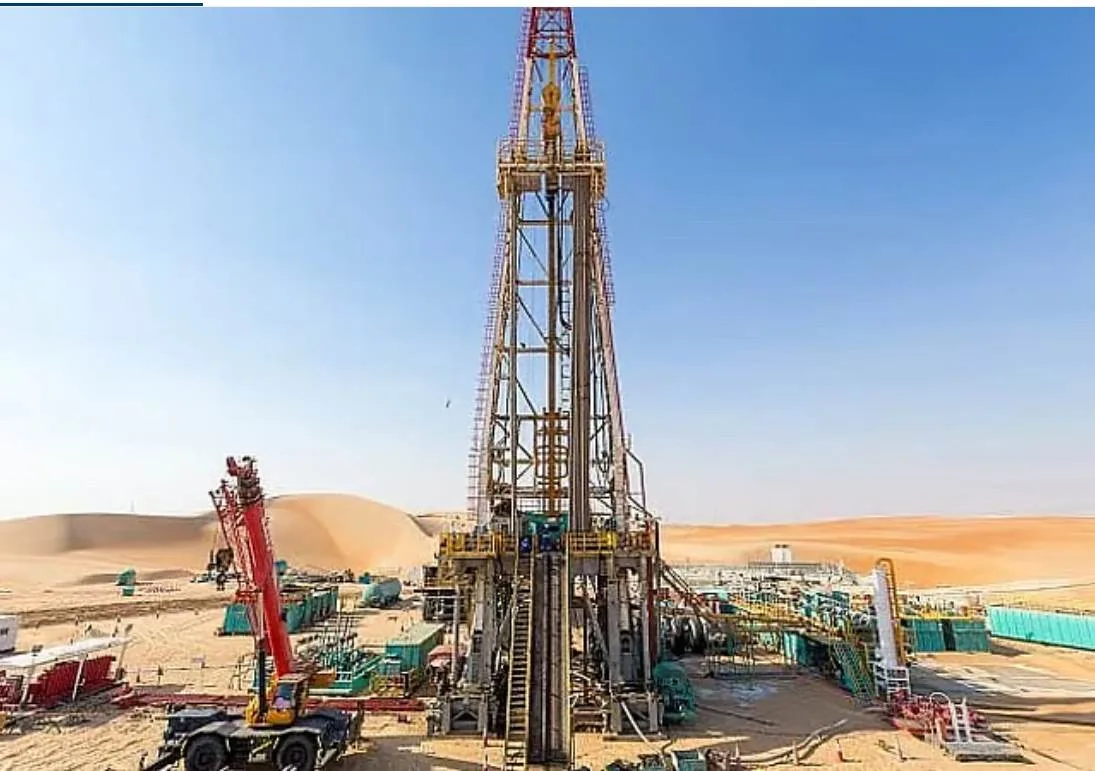
An ADNOC drilling rig in Abu Dhabi. Image: Gulf News.
A new bar for how fast energy assets get delivered
On 2 August, ADNOC announced it had drilled 6,428 feet in a single 24-hour period, routinely completing well sections longer than a mile in some of the UAE's most complex carbonate rock. The company credits its Real-Time Intelligence Centre (RTIC), where engineers, subsurface experts and operational specialists work around the clock on live well data, for making that pace possible. “Every well teaches the next,” said Abdulla Ateya Al Messabi, CEO of ADNOC Drilling.
Dr Ahmed Mohamed Alebri, CEO of ADNOC Onshore, framed the result as two things working together: ADNOC Onshore's understanding of its reservoirs and ADNOC Drilling's operational capability, unlocking more value from every well and speeding up production capacity. Every well generates thousands of data points, and it is the systematic capture and reuse of that data, not any single piece of equipment, that drives the improvement.
Most industrial assets don't get watched that closely
Wells are not the only industrial assets in the UAE's energy sector, and most of the others get nowhere near this level of continuous attention. Storage tanks, flare stacks, pipeline corridors, offshore platforms and process units typically get inspected on a scheduled cycle, often annual or biannual, set by regulation rather than by how the asset is actually performing. Between those inspections, corrosion under insulation, a loosening flange or a stress crack on a tank shell can go unnoticed for months.
That gap mattered less when everything else about asset management moved slowly too. It matters more now. As operators push well delivery and production capacity to move faster and safer using real-time data, the rest of the asset base is under the same pressure to keep up. A scheduled walk-down twice a year does not fit an operating philosophy built around continuous intelligence.
Can inspection actually keep pace with that?
It can, but only if it stops depending on people climbing tanks and scaffolding towers on a fixed calendar. Aerial and drone-based inspection covers flare stacks, tank farms, pipeline rights-of-way and elevated structures in a fraction of the time ground crews need, without shutting down operations or exposing personnel to work-at-height risk. Thermal imaging catches insulation breakdown and hot spots before they become a failure. Repeated flights on a fixed schedule turn that into a time-stamped condition history instead of a single snapshot.
That is the physical-asset equivalent of what ADNOC's RTIC does at the well level: replacing point-in-time checks with a continuous record that shows whether something is stable or getting worse.
Following the standard upward
None of this requires building a Real-Time Intelligence Centre. It does mean recognising that the benchmark for industrial asset management in the UAE just moved. Operators, EPC contractors and facilities teams running oil and gas, petrochemical or heavy industrial sites now have a working example of what continuous, data-driven operations look like at the wellhead. Applying the same logic to physical asset inspection — frequent, structured and comparable rather than periodic and manual — closes the gap between how fast wells get delivered and how carefully the assets around them get watched.
What a comparable standard looks like for physical assets
Start with the assets where an undetected fault carries the highest cost: flare stacks and elevated pipework, tank shells and roofs, pipeline crossings and rights-of-way exposed to weather and ground movement. Put each on a fixed inspection interval rather than the industry-standard annual walk-down, and capture thermal and visual data the same way every time so one flight can be compared directly against the last. A single inspection tells an operator what a tank looks like today; a time-stamped series, delivered as a digital twin, tells them whether a hot spot is new, stable or getting worse — the same question ADNOC's RTIC answers continuously at the well level, applied to steel and concrete.
About AIN UAE
GCAA & DCAA licensed drone data and inspection company
AIN UAE is based in Dubai, working with oil and gas operators, industrial site owners and EPC contractors across the UAE and GCC. We capture thermal and structural condition data on tanks, flare stacks, pipelines and elevated structures without halting operations, delivered as dated, comparable inspection records. If your inspection programme still runs on an annual calendar, we can talk through what a continuous approach would look like.
Talk through your inspection programme